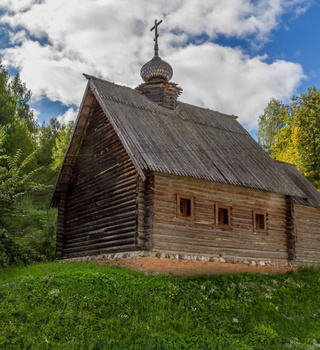
The Church of the Life-Giving Trinity in Plyos is a vivid example of cult architecture from the early 19th century, executed in the Baroque style. The history of the church begins with a wooden church that stood on this site since 1628. By 1778, there were already two wooden churches here - a summer and a winter (Vvedensky) church. In 1808, a stone parish church of the Trinity was erected on the site of the first wooden church.
Architectural Features
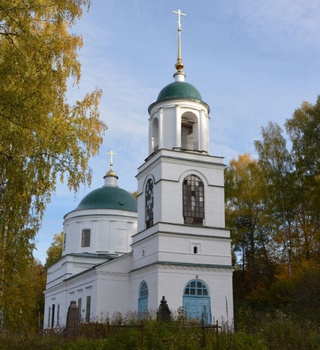
The church is executed in the Baroque style. The temple is a two-tiered quadrangle with an attic, crowned with five onion domes on octagonal drums. The semicircular altar and short refectory with rounded western corners are lowered to the level of the first tier of the quadrangle and slightly narrowed. The three-tiered bell tower of the church is distinguished by its pronounced vertical aspiration, with gradually diminishing quadrangles in plan with arched openings.
The Baroque decoration of the church includes high pedestal pilasters, developed entablatures, and tiers of frame platbands with ears and arched sandricks. In the attic decor, instead of traditional kokoshniks, figured panels are used, divided by short pilasters with niches at the corners. The main volume of the church is covered with a closed vault with a light ring of the drum, in the altar and refectory - flat ceilings, and in the lower tier of the bell tower - a cross vault.
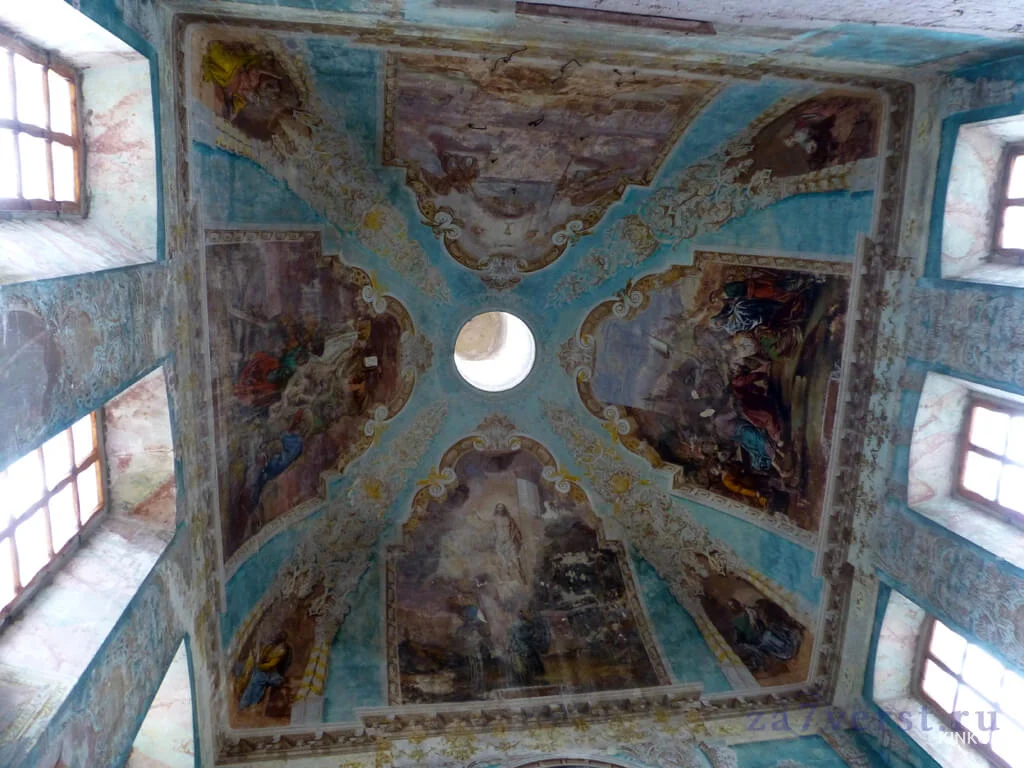
The glue painting in the main volume of the church is an expressive example of mid-19th century Baroque frescoes. On the vault, there are four large compositions: "Heavenly Jerusalem", "Carrying the Cross", "Descent from the Cross", and "Resurrection". In the corners, evangelists are depicted with double twisted columns on the sides. Baroque principles are traced in dynamic compositional solutions and a distinctly dramatic interpretation of events.
In the refectory, the oil painting of the mid-19th century was significantly damaged during the renovations of the late 19th and mid-20th centuries. On the ceiling is painted "The Last Judgment", and on the western wall - a rare composition on a biblical theme "The Test of Bitter Water" with a detailed depiction of everyday details.