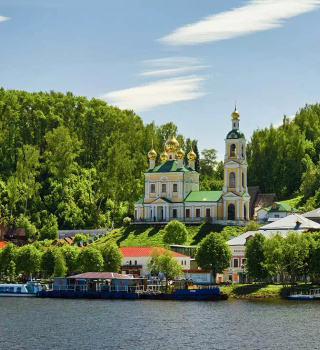
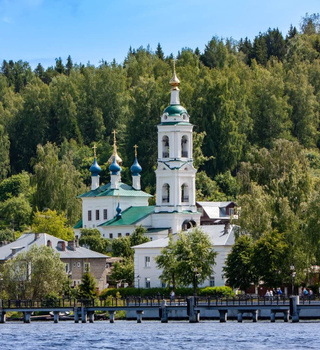
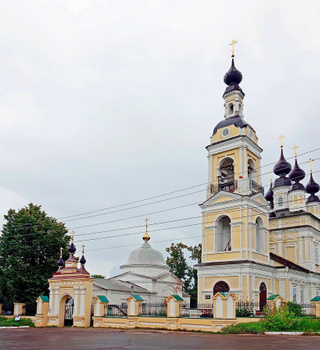
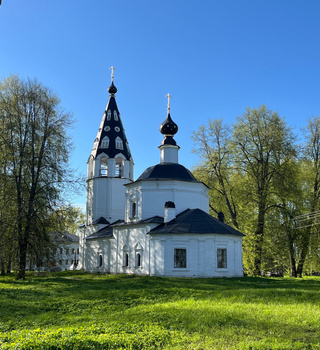
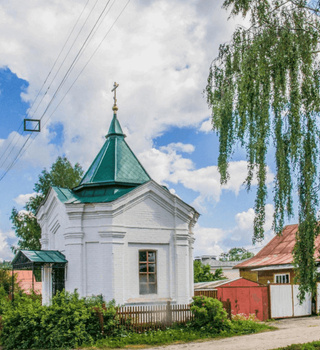
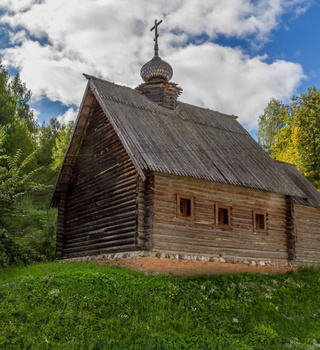
The Church of the Transfiguration of the Lord, located on the western outskirts of the town of Plyos, is a unique example of 19th-century religious architecture in the late classicism style. Built on the picturesque bank of the Volga, this church preserves the history and culture of the region, being an integral part of its spiritual and architectural heritage.
The church was erected in 1849 on the site of the male Spaso-Preobrazhensky Monastery, which was founded long before its first documented mention in 1667. According to legend, this monastery was founded by an unknown monk, and its existence significantly influenced the choice of location for the construction of the new church. The Spaso-Preobrazhensky Monastery was closed in February 1764, but its wooden Transfiguration Church, built in 1737, continued to function. The condition of the old church deteriorated over time, and in 1840-1849, a new stone church was built with donations from local believers.
Church Architecture
The architecture of the Church of the Transfiguration of the Lord represents late classicism with a distinctly monumental appearance. The main volume of the building consists of a large quadrangle with a prominent attic, above which rises a rotunda. The semicircular altar and the lowered refectory create a harmonious and majestic view. The decorative decoration of the temple is modest, with a flat character, including shallow rectangular niches, refectory and main tier of the quadrangle, moldings on the attic, and pilasters on the rotunda. The four-tiered bell tower, consisting of two quadrangles and an octagonal tier of ringing with a dome, adds completeness and grandeur to the structure.
The walls of the church have preserved 19th-century paintings. The church has three altars: the main one in honor of the Transfiguration of the Lord, the right one in honor of the Vladimir Icon of the Mother of God, and the left one in the name of St. Nicholas the Wonderworker.