Vasily I Dmitrievich (1371–1425) was the Grand Prince of Moscow from 1389, the eldest son of Dmitry Donskoy. His reign was marked by a policy of uniting Russian lands around the Moscow principality. During this period, the Nizhny Novgorod and Murom principalities, Bezhitsky Verkh, Vologda, Ustyug, and the Komi lands were annexed to Moscow. Vasily I actively led Russian troops against the Lithuanians and Tatar-Mongol invaders. He also refused to pay tribute to the Golden Horde, which led to an attack by Khan Edigu in 1408. Vasily I was forced to pay tribute to the Horde again but managed to hold Moscow and protect his lands.
Monument to Vasily I in Plyos
Monument to the founder of the city
We’ll plan your perfect trip to Plyos
Tell us what kind of holiday you’re planning in Plyos and what matters to you. We’ll help choose accommodation, interesting places, and activities that fit your wishes and budget.
Plan my tripFounder of Plyos
Despite the fact that a settlement existed on the site of modern Plyos long before Vasily I, he is considered the founder of the city. In 1410, by his order, a fortified customs and guard post was built, marking the beginning of the official history of the city. The Plyos fortress became part of a system of defensive structures that played an important role in protecting Moscow lands from Tatar and Lithuanian raids.
The Plyos fortress had strategic significance not only as a military object but also as part of the customs-defense system on the Volga trade route. This system included a fortress on the high right bank of the Volga, signal outposts, and stone ridges that hindered the free passage of ships. The system ensured control over movement along the Volga and protected Russian lands from external threats.
Installation of the Monument
The monument was installed in 1910 when Plyos celebrated the 500th anniversary of its founding. The ceremonial events included the invitation of high-ranking guests, a prayer service, a procession around the Cathedral Hill, and the installation of new bells on the Trinity Church. The monument was created by sculptor S. Alyoshin and depicted a bust of the prince in a fur hat and a wide-collared coat, corresponding to traditional images of Russian princes.
After the Revolution of 1917, the monument, like many others, was destroyed. Its bust lay on the banks of the Volga for some time before disappearing. It was only in the 1960s that it was accidentally found in one of the local history museums and stored under the name "Ivan the Terrible." In 2010, for the 600th anniversary of the city, an exact copy of the monument was made and installed in its original place, while the original is carefully preserved in the "Presence Places" museum in the exhibition "Ancient Plyos. Ivanovo Land."
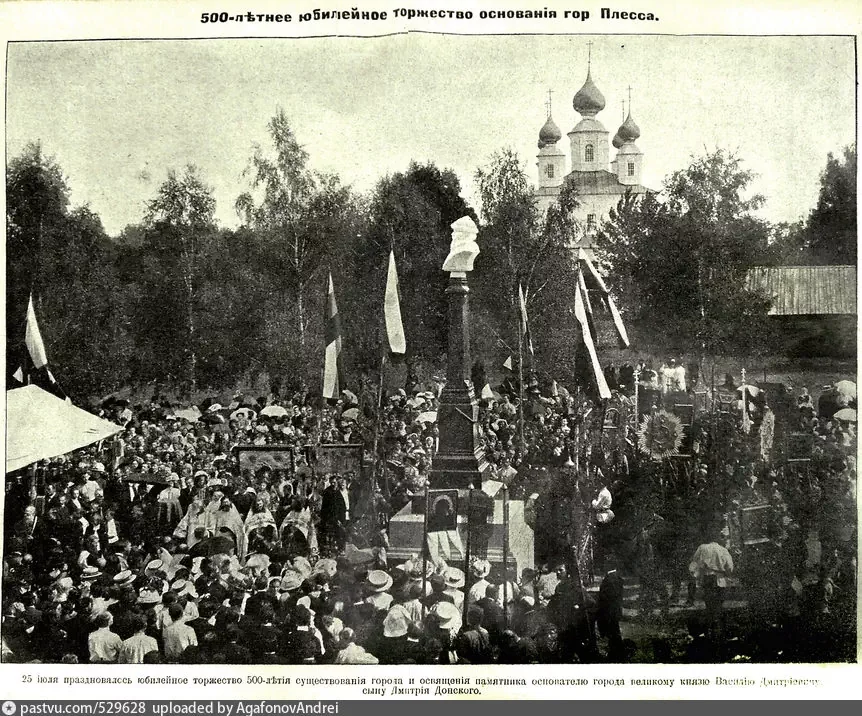

The monument is a bust of the prince on a tall, narrow black pedestal, surrounded by a beautiful patterned fence. The inscription on the monument reads: “Erected during the reign of Emperor Nicholas II in memory of the 500th anniversary of the city of Plyos, founded by Grand Prince Vasily Dmitrievich, son of Grand Prince Dmitry Donskoy. 1410-1910.” This bust is made of white marble and set on a dark granite pedestal.
Similar sculptures in Plyos