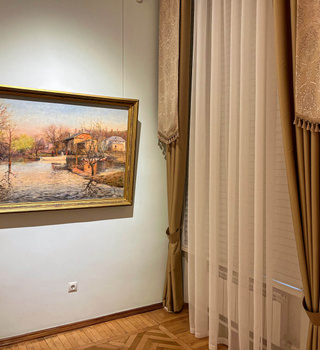
Exhibition of paintings by the People's Artist of the Russian Federation, Corresponding Member of the Russian Academy of Arts, Raisa Ivanovna Lebedeva (1940–2025). The exhibition is dedicated to the memory of the master and brings together about sixty works, created mainly in the last two decades of her life.
Raisa Lebedeva belonged to the tradition of the Moscow school of painting and consistently developed its artistic principles. Her works are distinguished by internal tension, expressive imagery, and psychological richness. She most fully revealed herself in easel painting, which became her key form of artistic expression.
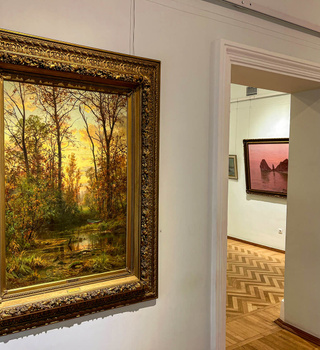
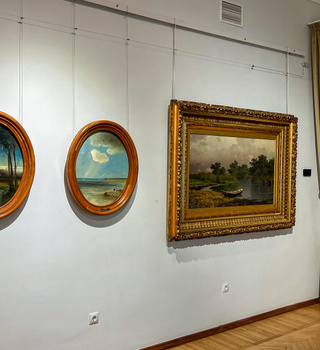
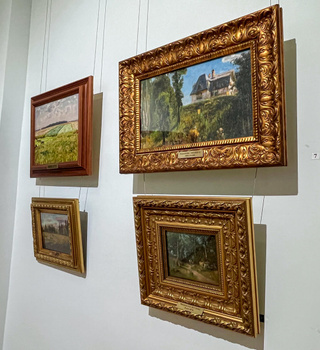
The presented works—mainly landscapes and still lifes—demonstrate a subtle sense of color and material. The artist worked with a wide range of emotional states: from intimate lyricism to dramatic intensity. Her palette is built on complex color relationships and nuances, allowing her to convey not only the external appearance of the object but also its internal energy.
Raisa Lebedeva formulated her understanding of painting very clearly: it is not a copy of reality, but the creation of an independent artistic world based on the observation of nature. This principle underlies the entire exhibition. In simple motifs—rhubarb leaves, household items, interior fragments—the artist found expressive form and deep meaning. Each canvas exists as an independent color and imagery system.
The master's biography is closely connected with the leading art schools of the country. Raisa Ivanovna was born in Moscow, graduated from the Penza Art School named after K. A. Savitsky, and then the Moscow Art Institute named after V. I. Surikov. She worked as a set designer at the Penza Theater, creating costume and decoration sketches, while also teaching. In 1977, she returned to the Surikov Institute as a teacher of the Department of Painting and Composition, nurturing a generation of artists known today in Russia and beyond.
She is also the author of theoretical publications on art issues. Raisa Lebedeva's works are in private collections in Russia, Canada, Germany, France, the United Kingdom, and Portugal.
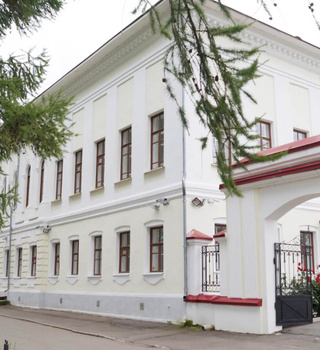
The exhibition in Plyos allows visitors to see the mature period of the artist's work and trace how tradition and personal artistic intonation are combined in her works.